


He seems like a happy person.
You can sit down with him over coffee, talk for three hours straight, and the time just flies. He’s sharp, he reads, and he always has some fascinating new rabbit hole he’s diving into. But if you pay close attention, you’ll notice something strange: he almost never talks about how he actually feels. Everything is always fine.
I first met Andy four years ago. Now he has seven publications on Substack. He can tell you the thinking behind each, and the thinking is good. Meanwhile, I get a mild panic attack just thinking about writing seven different About pages.
He’s thirty-seven. Before this he ran a small agency for six years and was good at it. Good enough that clients came back, good enough that he had four people working for him. Then he just shut it down. When people asked why, he gave them a perfectly reasonable explanation. But it wasn’t the real reason.
Then came the consulting. Then the thing with the ceramics, which he doesn‘t even bring up.
After his morning routine he sits down to write an article for one of his seven publications. Lately, he has been most passionate about the one on AI ethics.
He isn’t sure what he should write about. His next article is supposed to bring him more subscribers. He opens Substack, goes through his feed, gathers some information and throws it into Claude. The result is pretty good. A few minutes later he has an outline.
The conversation also gave him an idea for the positioning of one of his other publications. So he tightens his tagline. He feels amazing. Productive even. Like he is close to the breakthrough he has been waiting for.
Over lunch, Andy reads an article on how to scale a newsletter to six figures. He feels a slight rage because most of it is what he would call “superficial slop.” It would be easy for him to write a comment pointing out the obvious flaws.
But he knows some of it works. That’s the part that bothers him.
He‘s done the Enneagram. Depending on the year, he is Type One or Four. MBTI twice, a questionnaire on attachment style, eighteen months of reading on Internal Family Systems. He can tell you which part of him is protecting which other part and roughly when it got installed. He can describe his own avoidance patterns with more nuance than most licensed therapists.
He has bought four courses on personal branding. He finished one. The draft of his book is filed in a folder called “Someday.”
You probably think I made that last one up. Well, you’re right. I did. And to be honest there is no Andy. Or rather, there isn’t just one Andy. There are dozens of them and I get a message from one of them at least twice per week.
The Curse of Serial Reinvention
Here‘s what everyone gets wrong about Andy. Even Andy himself gets it wrong.
Look at that list again. The agency. The consulting. The ceramics. Everyone reads it as someone who can‘t commit. Andy has his own vocabulary: procrastination, perfectionism, no discipline, bad systems, sometimes ADHD.
There is one thing that all of them have in common. They frame his behavior as a malfunction. Andy thinks that something is wrong with him.
But he didn‘t fail at the agency. He built it, ran it for six years, and left. He wasn‘t bad at consulting either. He was good at it and then it bored him into the ground. He got good at marketing too, and that‘s the part he really doesn‘t talk about. He loved it right up to the point where the magic turned into manipulation.
As he starts to master something, a strange urge to pivot emerges. He quits the moment the thing threatens to become a permanent part of his identity.
Although his reasons for changing direction make perfect sense, he is tired of reinventing himself every few years. That‘s why he doesn‘t tell anyone about the ceramics.
When he looks for a solution, the creator economy has a whole package ready for him. Pick a niche. Be consistent. Post daily. Build in public.
He has tried them all. None of them worked. He thinks it’s a lack of discipline. At least that’s what the gurus want him to believe.
But he can be very disciplined about things he cares about. He goes to the gym. He meditates.
Then he sees some twenty-five-year-old kid teaching people how to build a business and making stupid amounts of money. The advice seems to work for everyone else, so why the hell doesn‘t it work for him?
The Creator Economy Is Made for Followers
This is the point where many creators find themselves.
They do all the right things but they are still stuck. It has nothing to do with them. The advice they receive from the creator economy is not just wrong for them. It’s horribly wrong.
Take a look at all the advice out there. It’s made for a specific type of person: a follower.
That’s not meant as an insult. Followers are neither stupid nor lazy. The gurus hand you a plan to execute and you follow it. If it does not work, there are usually two explanations.
Either the guru was a fraud, which leaves you intact and sends you looking for a better plan. Or you were not disciplined enough, not consistent enough, not good enough… That makes you the problem.
Unfortunately, most people go with the second one, because it is the one that keeps the hope alive.
Failure is not where the real problem shows up. Failure is survivable and repeatable, and that is exactly what the creator economy runs on. There is always a next course.
But what happens when the plan actually works? You follow the rules, you check the boxes, the metrics go up, and you’re suddenly making good money. Then, one morning, you wake up, look at the business you’ve spent five years building, and realize you built somebody else’s business.
It’s hard to admit you wasted years of your life, so you ignore that thought and continue. I know because that’s what happened to me. Twice.
Nobody sells a course on that. There is barely language for it. This is why the advice is wrong in a way that has nothing to do with whether the courses work or not.
I should be precise about what I mean by follower, because it leads us to the core of the actual problem. I like to think of it as a spectrum. The spectrum measures the degree of consciousness and individuation.1
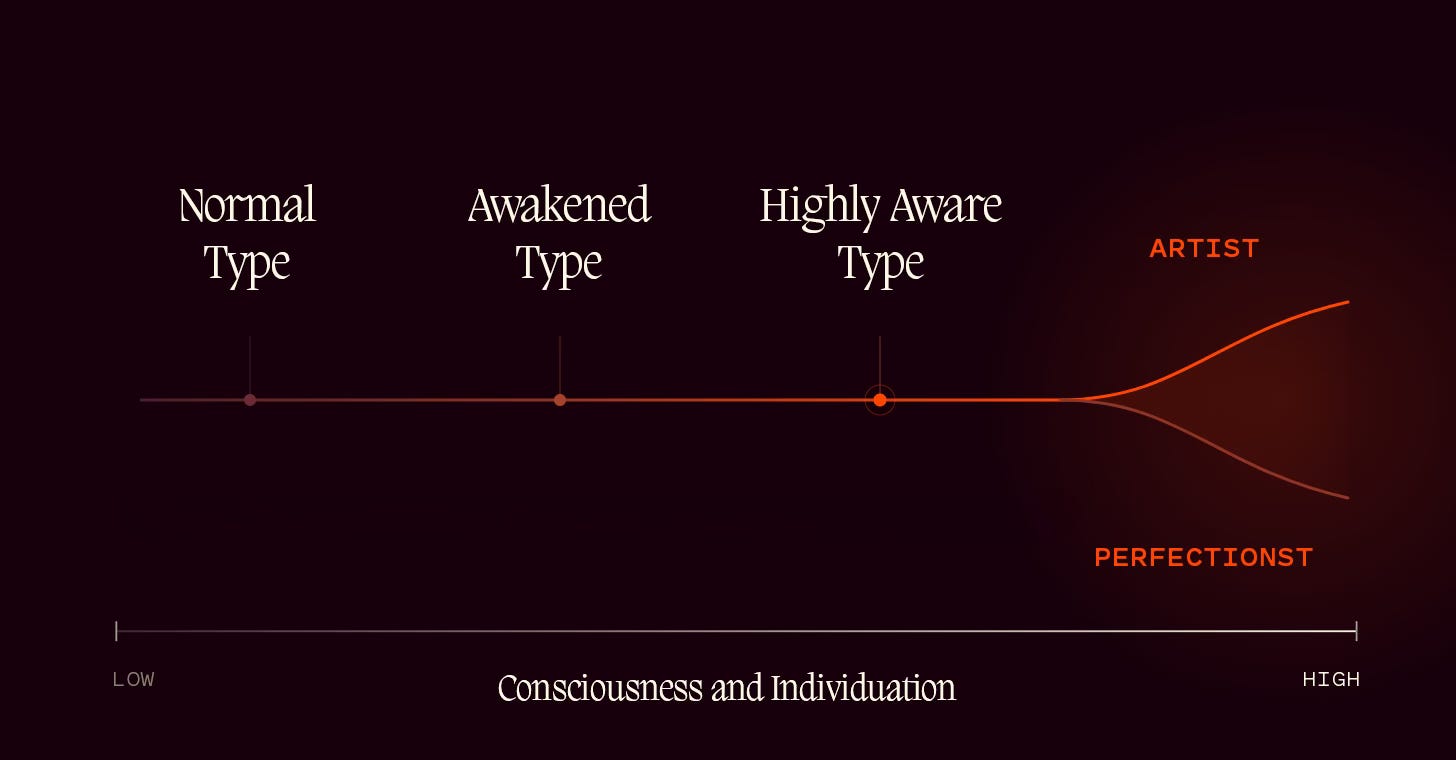
On the left you have the “normal” type. These are the people sleepwalking through life. They happily adopt the scripts handed to them by culture, family, and authority. They don‘t lose sleep over existential meaning because the rules are clear: do the job, buy the house, post the vacation photos. It’s the most comfortable place, but it is also where you are least in charge of your life.
In the middle you have the awakening zone. Something has cracked. These people realized the traditional script was a trap, so they broke out. They have gained a certain awareness about themselves and the world. Most of the creator economy lives here. They can see the system they are in, but they don’t have enough distance to see that they are still running a script.
The gurus like to say you have left the matrix.
But you have really just traded one for another.
On the right you have the highly aware types. They can see through the illusions of society and are individuated enough that they can’t go back. It sounds like this is a desirable state, but it comes at a high cost. There is no crowd to protect you. You have to stand fully by yourself, and that’s pretty scary.
If you’re still reading this, you’re probably on the right end of that spectrum. That means the advice of the creator economy doesn’t work for you, because it’s made for a completely different person.
No amount of discipline, skill or passion will make it work. The advice is destined to fail you.
It works for the people on the left because they are natural followers. They want to execute a plan and the gurus provide it. The gurus need followers because that gives them a god-like status. Even with good intentions they likely fall prey to the temptation to misuse their power.
The creator economy is built for people who want to follow a plan without having a boss.
Instead of teaching you how to become yourself, they teach you how to be like them.
The Introspection Trap
That’s why the advice is horribly wrong for someone on the individuated end of the spectrum. It tries to drag you back to the other side, which requires you to be less conscious. But there is no way back.
You can’t swallow someone else’s ambition. You need to affirm your own.
This might sound like you should never get help and never take a course. That is not what I am saying.
The problem is that most courses have a structural error. They need you to become a follower. That’s why everything inside the system has to make sense. They give you a worldview that pretends to be complete.
You can’t push against it. You have to swallow it as complete or admit that you wasted your time and money. The testimonials tell you the blueprints work. So people usually conclude that the problem is them. And they try to fix themselves through endless introspection.
This opens what I call the Introspection Trap. You can’t bear the pressure from outside, so you refuse to conform to what other people want from you. But you cannot bear the pressure from inside either, so you refuse to submit to the goals you set for yourself.
Except some of those goals were never really yours. Look at how they got there. They made rational sense and you agreed. You now have someone else’s goals dressed up as your own.
People on the left do this all the time. It’s how they live without inner conflict.
Even when niching down seems like the logical thing to do, you can’t execute it because it was never your idea in the first place. No wonder the draft stays at 90%. You can’t enslave your creative force to someone else‘s system. The only way left to express it is negatively, through refusal.
You have effectively turned your high consciousness against yourself.
Since you know you are smart and capable but cannot finish the thing that would actually count, you start to feel guilty. That makes you even more vulnerable to introspection. And it gives you the vocabulary to deny your creative force and justify its refusal: no discipline, bad systems, procrastination…
The result is over-thinking, paralysis and endless pivoting. Those are the exact symptoms we saw in Andy.
Why Smart People Get Stuck
On the right we actually have two types, and they are psychological twins. Neither of them can be a follower anymore.
The first is the Perfectionist, who has turned their awareness against themselves. They question everything and use their creative force for constant introspection. As a result they end up paralyzed. It’s like an engine that is running at full blast but stuck in neutral. Eventually the fear and the exhaustion burn them out.
Their twin is the Artist. In this context artist doesn’t mean you have to be Leonardo da Vinci. An Artist is simply someone who creates. That is what separates the Artist from the Perfectionist. The Artist uses their creative force to make something that exists outside themselves (a project, a text, or a business).
The Perfectionist suffers from their self-consciousness because they use it to analyze reality. The Artist thrives on their self-consciousness because they use it to form reality.
As you can see both types are almost identical. The difference is where their energy flows.
You have probably guessed it by now. Andy is a Perfectionist. He keeps pivoting because his creative force refuses to be boxed in by someone else’s formula.
But he is looking for something perfect. That creates the same pressure from the inside as a set formula does from the outside.
The Perfectionist gets stuck in an endless quest for clarity fueled by their desire for self-knowledge. The sneaky thing is that it works. Every time you uncover an insight, you get a dopamine hit of clarity. But nothing ever leaves your head.
I’m not arguing against introspection. My point is that too much introspection is making you sick while tricking you into believing you’re healing.
When someone like Andy steps away from the “follower“ path, they inevitably feel like something is off. But because they’ve been conditioned by the blueprints, they interpret this natural friction as proof that they are broken.
So they panic. They buy another book, take another personality test, and retreat back into their head to “solve“ a problem that was never a problem to begin with.
Total Clarity Is an Illusion
We have this idea that our favorite writers never procrastinate. They just sit down and write in a state of flow. If we are honest with ourselves, we know it’s an illusion. We like to believe it because it gives us the perfect excuse: we don’t have what it takes. We are looking for relief that doesn’t exist.
Every day the Artist sits down to write. It feels heavy. Changing the About page for the third time this month seems like the perfect thing to do. But the Artist also knows that this will not have the impact they want. It’s through their body of work that they can inspire people.
That heaviness never goes away. I want to be clear about this, because most people promise you the opposite.
You don’t find something magical like clarity, confidence or purpose and suddenly everything gets easy. If that’s what you’re looking for, you’re better off with a Disney+ subscription.
Becoming an Artist doesn‘t make things easier. You sit down to write and feel the same resistance. It’s the same urge to procrastinate.
What changes is the direction of this urge.
Before, it went into the tagline. Now it goes into the article. The Perfectionist concludes they are not ready yet. The Artist knows that creation has to hurt. They accept the pain and use it as fuel. By doing this they change the meaning of the pain.
The Perfectionist uses their personality as a hiding place. The Artist uses theirs as a container. Only one of them is building a body of work.
A business is just a vehicle to share your art with the world. And the real art happens when your work becomes an honest reflection of who you actually are.
What are you going to do after reading this article?
If you came here to find clarity or relief, I’m going to disappoint you. There is no framework, because you don’t need one. You already have the raw material. What you don‘t have is permission from yourself, and nobody can give you that.
It will not get easier. No hack is going to save you. The heaviness you feel when you sit down to write is the price you have to pay for making something that‘s yours.
Now channel that pain into your work. It‘ll probably be worse than you want it to be. The thing that matters is that it finally left the folder called “Someday.”
P.S. One more thing before you go.
Reading an article like this is easy. You read it. It resonates. You feel a brief flash of relief. And tomorrow, nothing changes.
I get messages from people like Andy every week, and almost all of them end with the same question: “Okay, so what do I actually do now?”
That’s why I’m opening the Atelier. It’s an eight-week working environment for ten people, staring in October.
I spent tens of thousands of dollars on courses trying to figure this out. One of them left me broke in my parents’ basement. Another one made me good money, but I was building a business that wasn’t mine. What took me years to see is that all of them had the same effect. They distracted me from the actual thing. Standing on your own is scary, and a course gives you somewhere to put that fear. It makes sense logically and it gives you all the right reasons emotionally, but you never arrive. Something always feels off.
That’s what the Atelier is. You work on your own stuff every day, even if it’s only thirty minutes. You get paired with a partner who matches your psychology and progress. They're not there to fix your headlines or edit your sentences, there are plenty of writing groups for that. They tell you what keeps showing up in your work, what it's really about underneath, and what you can't see because you're too close to it.
Once a week we also meet live, and I work through one person's material in front of the group. So no more shouting into silence and wondering if you should start over again. By the end you'll know what your body of work is about, the thing that ties together everything you've done so far, even the parts you thought were detours. And you'll have the first piece of it ready to go out into the world.
If you’re tired of starting over every few years and you want to finally build something that’s yours, this is for you.
Note that while I call them types, the boundaries are blurry.
So true: Perfectionist and Artist. There is a constant battle between the two. Sometimes one wins , sometimes the other. And often this is another form of stagnation, or a truce, where nothing much changes.
I'm in the process, or I think I am in the process, or at least it feels that way, where the Artist is taking the throne more often now, and asserting a new law over the land, though the Perfectionist doesn't like it very much.