


There is no better feeling than starting something new.
Actually, wait, no. It doesn’t even have to be something new. You get the same high when you burn something old down and start over. I can’t count how many times I rebranded my studio. I call it a branding and design studio, but rebranding and design studio is probably way more accurate.
It usually comes out of nowhere. You are thinking about some random things and suddenly something clicks.
I should open a café.
It feels exciting because in a matter of ten minutes you have laid out a whole business plan. You know where to source the beans, how the interior design will look, and how it perfectly aligns with your newly discovered passion for artisanal pastry.
You can’t stop thinking about it because this time it is closer to who you really are. So the next day you buy the domain and set up the page. You feel alive. Nervous even. Because this could be something big.
But you have done this before. There was the podcast, the YouTube channel, the coaching business. Somewhere there is even an old account with a few thousand followers that you stopped posting on because it started to feel like a chore. And then there are the three courses you never finished.
You were committed every time. You really wanted to go all-in, but at some point it just didn’t feel like you anymore. It wasn’t really fulfilling. And then came the next thing that seemed more aligned.
After the fourth or fifth time you start to wonder if something is wrong with you. Maybe you are not made for this. Maybe you will keep reinventing yourself every few years until you run out of years. You have never been busier, and you have never felt so stuck.
I used to think something was wrong with me too. It took me years to realize that I was stuck in a stage.
Most people wouldn’t call this a stage. Usually they use words like multi-passionate, polymath, generalist, Renaissance man. It’s great because it gives you an identity. It explains why you are like this and it feels liberating. “I don’t lack commitment, I’m a Synthesizer.”
This is highly marketable garbage. As much as I’m a proponent of self-acceptance, it just gives you a better vocabulary for staying stuck.
A beautiful label makes running in circles look like intellectual superiority. If starting over feels so good and the label tells you it’s just who you are, why would you ever stop?
So why does nobody call it a stage? I think it has to do with how the creator economy works.
How NOT To Be Yourself
Society has grown more individualistic over the past several decades. Strong collective ideologies, like traditional religion, have been slowly vanishing. A couple of hundred years ago, your church or your tribe handed you a script for your life, and that was that. Today, you are basically left to your own devices.
People are increasingly looking for more freedom. As a result, for many a regular 9-to-5 job doesn’t cut it anymore. But society has not caught up to provide an alternative model. That’s how many of them end up in the creator economy.
The creator economy seems to present them with the perfect alternative. It even comes with a fitting slogan: just be yourself.
It sounds great. Almost liberating. But it’s also completely empty. Who else would you be? Yet what I see is mostly copycats.
It’s funny because the same people who shout “just be yourself” also say that you should imitate others. Nobody is going to tell you what to do. So what do you do if you have no idea how to build your own thing? Right, you copy the guy with a lot of followers who seems to have made it. You clone his posting schedule, steal his copywriting templates, and adopt his obnoxious habit of starting every other sentence with “Read that again.”
The Steroid Problem
Look, I’m not saying imitation doesn’t work. If you are just starting out at something it makes sense to look for a role model. That’s how I approached almost anything I wanted to learn. Imitation is a necessary part of the process. In some cases, though, it doesn’t really help.
I remember when I started hitting the gym. At that time magazines were still a thing, so I picked up a fitness magazine called “Muscle & Fitness.” The guys were huge. Ripped. Some were more muscle than anything else. I didn’t really want to look like them but I reasoned they must know something. I trusted their authority.
They shared their training and nutrition plans and I followed them. For years. It took me a long time to understand that these guys were using steroids. They had altered their biology, so their plans only worked if you took steroids as well.
In retrospect it’s obvious. But the same thing happens with business advice. You see the guy who made a lot of money with personal branding. You can see how many followers he has. Sometimes he humble brags about his revenue (obviously, he never shares profit). So you reason that this is a great business model.
You can copy his plan, but you can’t copy what made it work for him. If you learn anything at all, it’s the craft. But business is not a craft. It is an art.
The Renaissance Was Onto Something
Learning by imitation is nothing new. What we see in the creator economy is similar to the master-apprentice system during the Renaissance. A young student would enter a master’s workshop to learn the complete trade of art and craftsmanship. Students learned by carefully copying the master’s preparatory drawings or masterworks. During this period they were highly influenced by the master. A well-known example is Michelangelo training under Domenico Ghirlandaio.1
But the apprenticeship was only the beginning. It was followed by a phase as a journeyman, traveling to refine techniques and build a professional reputation. In Germany (where I was born) this tradition still exists.2 Journeymen were qualified to work independently but traveled to work under different masters. As a final test they had to submit a masterpiece to a guild committee to prove their skills.
Leaving the master’s shop was a mandatory part of the process. The journeyman wasn’t lost. They knew that they were working towards something and each workshop was adding something to it.
There is a huge difference between the Renaissance model and the creator economy. In the old workshop the master made his living from his work. The apprentices helped him make it. In the creator economy the master makes his living from the apprentices.
That’s a different business model with different incentives. A master wanted his pupils to get better because it directly reflected on his work and reputation.
To become a master and teach people in the Renaissance you had to go through years of training, years on the road and finally make a masterpiece. In the creator economy none of this is required. Many creators teaching today built an audience over years, sometimes without real skill and often helped by luck.
Today it’s more important to have a large following. The quality of the work is secondary. The gurus need followers to legitimize their right to teach. So nobody has an interest in sending you on the road. And most of them couldn’t, because they never walked it themselves.
The creator economy is made for followers. There is no place for the journeyman. That’s why so many creators feel lost or stuck. They can’t see the path ahead.
Nobody Can Teach You Art
The Renaissance produced some of the greatest artists in history. But the workshop didn’t make them artists. It gave them a craft and a map. Everything else was on them.
A system can pass on a craft. Nobody can pass on the art.
That’s what only you can make. To understand why so many capable people get stuck right there, we need a different kind of model.
I believe in a psychological definition of an artist. Over the years I kept seeing the same patterns, in the creators I work with and in myself. Eventually I developed a model with four stages.3
If we reduce the whole model to one question it would be this: How do you handle your difference from others?
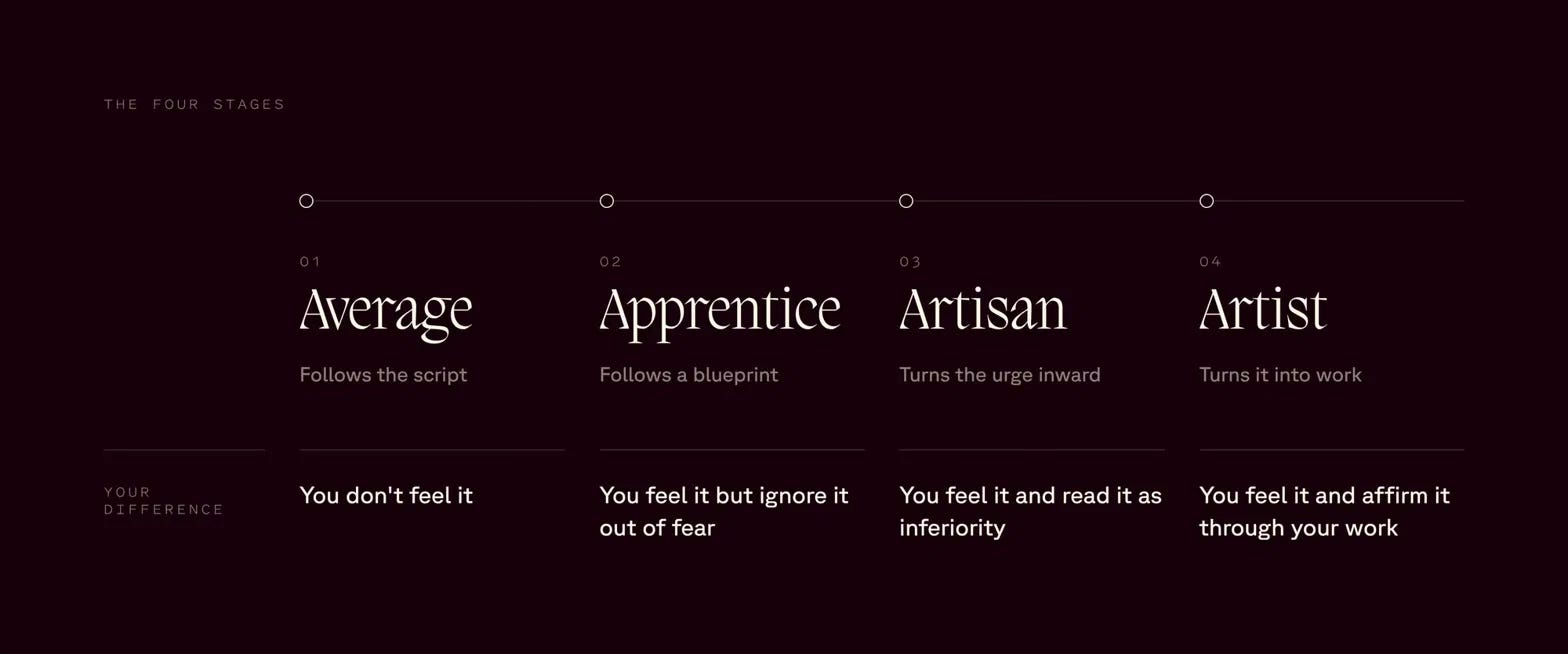
In the Average stage you don’t feel a difference at all. In the Apprentice stage you start to feel it somewhat but ignore it because of fear. In the Artisan stage you feel it and interpret it as inferiority. In the Artist stage you feel it and affirm it through your work.
Now I should note that there is no moral judgment in any of the stages. None is inherently better than the other. The model is built with creative people in mind.
The Average Stage
The Average stage is where almost everyone starts. For most people this means working a regular 9-to-5 job, a house in the suburbs with a partner and two kids, and squeezing in a little free time between paying bills and enjoying family weekends.
More important, though, is the psychological side. You follow the dominant script laid out by society. It provides your life with structure and security. You never really feel your difference because the ideal is to be like everyone around you.
Many are happy here, so they never question the path in front of them.
The Apprentice Stage
What happens when the average life stops making you happy? You feel that something doesn’t sit right. It isn’t fulfilling you and you can’t ignore it anymore. Then you come across people who seem to be happier, more fulfilled, more independent. You resonate with their ideas and look for how they did it.
I call this the Apprentice stage. This is usually the entry point to the creator economy.
At some point you feel a strong inner conflict. The creator economy puts almost impossible demands on people. Creators are supposed to have a highly differentiated, unique personality. At the same time society demands a well-adjusted, normal citizen. For most creators it’s hard to bear this conflict, so they are torn between standing out and fitting in.
It’s for this reason that many creators are susceptible to the gurus of the creator economy. A guru gives you a blueprint that makes you feel like a unique individual while giving you the protection of a small group at the same time. In the Average stage you are fully immersed in the crowd. In the Apprentice stage you stick slightly out of the crowd, but the guru still gives you enough protection that you feel safe.
That’s why it’s so important that gurus have a large enough following. The following is the protection.
Transitioning from the Average stage, many people are happy to find a model they can follow. The blueprint protects you from standing out (less guilt) and tells you what to do next (less fear).
After about one or two years in this stage, disillusionment starts to kick in. You start to notice serious flaws in the model of the guru or you realize that it was more of a scam than an actual course.
It doesn’t mean the guru was bad. Their power comes from a natural dependence, but giving up on this dependence is painful. The help becomes a burden when you outgrow it.
Many people give up at this point, most even before that. Some people go straight to the next guru to find a better blueprint. The cycle starts again. A few see through the illusion and the guru loses their power over them.
They know they have to do it on their own. They have so much material that they need their own system.
The Artisan Stage
“I’m lost.”
It’s a sentence I hear at least once a week from people I work with. Some might not say it directly but it becomes obvious quite fast. I think many people don’t want to say it out loud because society tells you that you are not supposed to feel lost. Worse, it implies that something is wrong with you.
This is the Artisan stage. Creators here have years, even decades, of experience, real skills and something unique to contribute. They stick out of the crowd completely and at the same time can’t get the protection of a guru.
When you create something of your own, there is nobody giving you permission. That’s when a voice in your head starts asking: Who are you to say this?
I think it’s dangerous to call this state “lost.” It implies that you have to find yourself, so you go out looking for a path or you start an inner journey of introspection. That gives you some comfort. You might even get the impression you have found yourself. The problem is that you were never lost to begin with.
You are on the road. You just don’t have a name for it.
I see two ways creators deal with this.
1. The Perfectionist
They have a dozen projects but none ever gets finished. As they get close to finishing one, a new one appears and it seems like this could be something big.
I think the reason is that every project has to carry their whole self. No single piece of work can do that. So nothing gets finished.
Finishing is an ending, and every ending is a small death.
So right when a project threatens to become part of their identity, a new, more appealing idea shows up.
Interestingly, creators in this stage are almost blind to their situation. They sense that something is wrong but they don’t think they need help. They can describe their problem better than anyone else, yet they can’t solve it themselves. That’s the tragic part because they think they can solve it through more insight. Their energy drains into consumption: courses, books, research, one more framework. But more insight only makes it worse.
2. The Workaholic
They publish constantly. They launch one thing after another and work more than anyone around them. But it never feels like enough, so they make more.
The work is not a form of expression for the Workaholic. Working acts as a painkiller and has to be applied again and again.
They are like a journeyman who keeps working in other people’s workshops and never makes his own masterpiece.
Both traps come from the same fear: choosing one thing feels like killing all the others. So they never fully commit. Nothing adds up to a body of work.
They are afraid that if they pick the wrong thing, they will waste years. The doubt is actually proof of their creative energy. Someone without a will of their own just follows the plan. There is nothing to doubt.
You don’t have to choose one passion.
The key lies in channeling all your passions into one body of work.
I think for many creators in the Artisan stage the act of creation is what moves them forward. Writing suits this perfectly. The creators here have the skills and the material. What most of them lack is a regular practice of writing.
The effect comes over time. You can’t just stop after publishing one article. The danger here is that you use work as a means of compensating. That’s the Workaholic’s trap.
The Artist Stage
From the outside the Artist and the Artisan seem almost the same. Both have skills, both are passionate, and both have an immense drive to create. In some cases they might even create the same things. The main difference is really in their attitude towards creation.
The Artisan can be seen as a blocked Artist.
Many creators are blocked Artists.
The Artist not only accepts, but also affirms their own difference. The Artisan can’t bring themselves to do it. The Artisan interprets their uniqueness as a flaw. So they point their creative urge against themselves: more planning, more analysis, another restart. The Artist points it outward into the world by creating a body of work.
This is where “just be yourself” becomes dangerous. For the Artisan it means affirming the wrong thing: the self-consciousness that keeps them stuck. What they really need is to decide who they want to become and build it through their work.
That means the Artist stops comparing themselves and what they want to create against external models. The Artist creates themselves, but they can’t do it in a vacuum. The work has to reach people. You can’t force that. The audience has to see themselves reflected in the work. That only works if the Artist pours themselves into it. The Workaholic creates plenty of work, but none of it really comes from them.
You can’t make yourself an Artist just by declaring you are one, nor does an audience alone make you one. You can be an Artist with a small audience and an Artisan with a huge one.
The Artist has the same doubts and fears as the Artisan, but the Artist doesn’t wait for them to go away. The Artist channels them into a body of work. Piece by piece, day by day.
Great Work Doesn’t Come From Starting
So many creators get stuck or feel lost because they don’t realize that they are in a stage. Most try to solve this with more discipline, learning more or working harder. Even knowing which stage you are in won’t help if it doesn’t come with an emotional experience that leads to a psychological change.
No article can do that for you. In the beginning I said there is no better feeling than starting something new. Actually, that’s not true. Finishing something feels much better. It’s harder because a part of you has to die. When you let it, something new can be born.
Starting a café is a seductive idea. I thought it through many times. I even have several business plans for different cities. But I know I will probably never start one. After the excitement of a new idea wears off there is not much left.
A body of work is different. One piece rarely changes much. Twenty pieces start to change you. Once you share them with an audience, they change other people too. That’s when a body of work becomes art.
When someone reads your work and sees themselves in it, something changes that no words can describe. For a moment two individuals are united.
It might be impossible to know who you are without expressing yourself.4
So the next time something clicks, don’t ask if this idea is finally closer to who you really are. Ask what you would have to finish first.
P.S. For many creators it’s difficult to make the transition into the Artist stage on their own. That’s why I’m building The Salon. It’s a small circle for creators who are overflowing with ideas and drafts but have no body of work. You will be surrounded by people who refuse to be content creators. When everyone around you is finishing their own work, it gets harder to keep starting over. There will be live sessions where I go deep into one member’s work and show how the pieces connect. You will also be paired with a partner I select by hand. The Salon opens soon.
If you have many interests and the idea of a niche is making you sick, this might be for you. You have plenty of material. In the Salon it will become a body of work.
Michelangelo later had his biographer Ascanio Condivi claim that he was self-taught and owed Ghirlandaio nothing. In the 1568 edition of his Lives, Giorgio Vasari answered by quoting the apprenticeship contract.
Albrecht Dürer did the same in the Renaissance. After his apprenticeship with Michael Wolgemut in Nuremberg, he spent about four years on the road, roughly from 1490 to 1494.
A first version of this model appeared in my essay How Multi-Passionate Writers Paralyze Themselves. I saw the stages first. Only afterwards did I notice that the Renaissance provided a great analogy for it.
I wrote about this in Please Don’t Find Your Purpose. The greatest work you will ever produce is the creation of your own personality.
This was really insightful and relatable. Several years ago I had a vision for a writing program I was SO excited by. It all just poured into me so clearly and I felt I could have written it in a couple days. I wrote out a skeleton of it and posted about it online and even started gathering a waiting list of eager potential participants. Through gritted teeth I forced myself to finish another project first and as soon as I went to start creating my writing program, I lost it. I couldn't remember half of what had kept me up for nights dreaming about. I couldn't get the energy back or the insights I was bursting to share. It honestly felt like a great loss I'm still grieving. And the memory of that loss has stayed stuck in my body. I feel like if I don't jump into my passionate idea then I'll lose it and still be grieving it ten years later.
What a powerful essay, Philipp! So much here to reflect on, and so much I recognize in myself.
I think you've captured something essential about modern life. We grow up following a familiar script: study, find a good job, build a career, become a useful and respectable member of society. And for a while, it works. Until one day we begin to feel that something is missing.
We start looking for something of our own. Something that would allow us to express all those thoughts and feelings that have been quietly growing inside us for years. The result of our mistakes, experiments, observations, books we've read, and, of course, countless courses we've taken. :)
I particularly loved your Renaissance analogy and the four stages of becoming a master or an artist. There was no shortcut. Years of apprenticeship, endless repetition, hard work, and gradually discovering your own style. Sometimes it took half a lifetime.
And here we are in the creator economy, surrounded by promises of overnight success, instant audiences, and financial freedom in six easy steps. What could possibly go wrong?
I also recognized myself in your descriptions. I'm probably a mixture of the Perfectionist and the Workaholic. I get excited about an idea, throw myself into a new project, spend countless hours researching, experimenting, and trying to build the perfect system. Then another fascinating idea comes along, and the whole cycle begins again.
But the part that moved me most was this:
"When someone reads your work and sees themselves in it, something changes that no words can describe. For a moment two individuals are united."
That's exactly what makes writing so meaningful to me. We put our thoughts, doubts, and vulnerabilities out into the world, and somehow a stranger recognizes something of their own life in them.
Even one sincere comment from someone who saw themselves or their situation differently because of something I wrote can make all those hours worthwhile.
Perhaps that's what we sometimes forget while chasing growth and trying to become better creators. We're not just building publications or audiences. We're slowly finding our own voices, and occasionally helping someone else understand theirs.
Thank you, Philipp. This gave me a lot to think about.